Book Review: Seraph on the Suwanee, by Zora Neale Hurston

“Putting food on the table” is what both husbands and wives do. In traditional marriages, however, the husband does it figuratively while the wife does it literally. The separateness of these two modes of devotion leads both husbands and wives to feel that they are laboring alone, and both grow resentful.

In Seraph on the Suwanee, the husband, Jim Meserve, makes clear from the outset that his view of marriage is not as an equal partnership. As he conveys “in so many words” to wife-to-be Arvay Henson, “‘Love and marry me and sleep with me. That is all I need you for. Your brains are not sufficient to help me with my work; you can’t think with me. Let’s get this thing straight in the beginning.’” (p. 35) Indeed, Jim’s idea of connubial sex is quite explicit: “‘Sure you was raped, and that ain’t all. You’re going to keep on getting raped.’” (p. 57)

As Arvay is Seraph’s protagonist, the course of her resentment at this type of marriage forms the main thread of the narrative. What’s surprising – or perhaps unsurprising, given a grasp of human nature in all its irony – is how much Jim resents it too:

‘I feel and believe that you do love me, Arvay, but I don’t want that stand-still, hap-hazard kind of love. I’m just as hungry as a dog for a knowing and a doing love. You love like a coward. Don’t take no steps at all. Just stand around and hope for things to happen out right. Unthankful and unknowing like a hog under an accord tree. Eating and grunting with your ears hanging over your eyes, and never even looking up to see where the acorns are coming from. What satisfaction can I get out of that kind of love, Arvay?’ (p. 262)

Adding complexity to this story of resentment is its symbolism, with the “cracker” Arvay representing the Old South and the hustling Jim standing for the New. Perhaps the former, sullen and parochial, can only be dragged forward by the latter, enterprising and propulsive; and perhaps this dragging does not allow for much collaboration or consultation. It’s certainly ironic that a progressive development  – the modernization of the South – should be depicted here in the context of an unprogressive marriage: Arvay finds her liberation in submission, and if any beneficial readjustment of marriage roles takes place, then I must have missed it. It may be that Hurston prizes the social and economic improvement of the South over the raising of the status of women…

…or maybe her point is that the South hasn’t quite changed enough. Otherwise, it’s very strange for Hurston to have painted Jim as such a know-it-all of a husband, only to admit in the end that hubby really does know best.

Book Review: Eyes Like the Sea, by Mór Jókai

(‘You have a rich aunt at Ó Gyalla, and you’ve only got to say a word to her and she’ll get your book printed for you. I suppose you’ve only got to ask her?’

‘I shall not tell my rich aunt a word about it.’

‘Then you’ll get your book printed at Fani Weinmüller’s, I suppose. Now listen, that won’t do at all. I know an author who published his own book and went from village to village, and persuaded every landed proprietor to buy a copy from him. That is a rugged path.’

‘My romance will not be one of those which the author himself has to carry from door to door; it will be one of those for which the publisher pays the author an honorarium.’

She absolutely laughed in my face.

[pp. 25-26 of 1894 edition])

Is Bessy, whose Eyes are Like the Sea, a feminist hero or a flighty ditz? Herein may be discerned the opinion of her delineator:

I could not help laying my hand on hers. What true, what noble sentiments were slumbering in that heart! If only she had some one to awaken them! What an excellent lady might have been made out of this woman, if she had only met with a husband who, in the most ordinary acceptance of the word, had been a good fellow, as is really the case with about nine men out of every ten. Why should she have always managed to draw the unlucky tenth out of the urn of destiny? (p. 353)

Female nobility, then, is a potential, to be unlocked by a man. This system hardly admits of female agency, but at least Bessy is no femme fatale: She is not a bad thing that happens to men but a person to whom bad men happen. (Women acting through men is a common sight in another of Jókai’s works, Midst the Wild Carpathians.)

Of course, it’s all very beautiful and sad:

‘You do not know me. A man might make a she-devil of me, though he built a temple in my name straight off, enshrined me on the altar, and knelt down before me. But he whom I truly loved might make an angel of me. I could be happy anywhere: in a shepherd’s hut, a strolling player’s tent, at a soldier’s bivouac, in a schoolmaster’s clay cabin. I would dream of luxury on my bed of straw.’

And with that, she threw herself at full length on my bare sofa, and clasped her hands above her head. (pp. 37-38)

Book Review: Tales of Ming Courtesans, by Alice Poon

Tales of Ming Courtesans is a freedom book. Utilizing an approach that is very different from Lisa See’s in her Peony in Love, Alice Poon has created characters that do more than make the most of miserable situations. Rather, they rail at the injustice of them and seek liberation. In one passage, Poon credits very liberal expressions to the Hangzhou merchant Wang Wei and includes a ringing endorsement from Liu Rushi, perhaps the most intrepid of the three Ming courtesans portrayed in this book:

‘Confucius was dead wrong to have classed women as inferior humans. Just think of all the female talent that has gone to waste over the past several millennia because of that stupid gender discrimination! Aiya, too tragic! And our society is so depraved to exploit girls from poor families and allow the thin horse [human trafficking and procurement] trade to thrive! Why aren’t learned men ashamed at just ignoring it and do nothing about it! Let me tell you this: [Qian] Qianyi and I have always shared the same view on this issue. We have even planned to jointly petition the Emperor to ban the slave trade. That’s why we are great friends!’

‘Ah, now I understand why you call your boat the “Untethered Villa”! You are a freedom lover, true? Wasn’t it the Song poet Su Shi who had used the term “untethered boat” to portray his freedom from the burdens of officialdom?’ (p. 183)

Such discourse was indeed atypical of old China, but it was not unimaginable in the late Ming dynasty, when traditional dogma came under bold scrutiny and received norms of gender relations were challenged. Of course, Liu Rushi and her sisters are not merely interested in “freedom from the burdens of officialdom” but are desperately seeking to escape from brutal chains of control and chronic abasement. As their desperation increases, idealistic talk of freedom fades, and only the struggle for survival remains.

Nonetheless, they fight the good fight. Tales of Ming Courtesans is compelling and very exciting – and hard to put down. Readers will be sorry when it’s over, and if they are like me, they will be eager to learn more about Liu Rushi and her extraordinarily forward-thinking times.

Tales of Old Beijing: The Modern Plaza Incident of 1999

The Modern Plaza sits across the street from People’s University and is accessible from it by footbridge. Its most significant architectural feature (for our purposes) is the fact that its second floor is bigger than its ground floor, creating a covered area in which temporary sales or exhibition tables may be placed.

One day (August 9, 1999) I left campus, crossed the footbridge, and made for the Modern Plaza, to pick up a few sundries. As I neared the entrance, I noticed that a special sale was indeed in progress under the overhang. About twenty high school girls were engaged in the campaign. They wore identical corporate t-shirts and were hawking what appeared to be cosmetics. The energetic young ladies beckoned me over, but I held up my index finger, signifying that I wished to complete my indoor shopping first but would be right back.

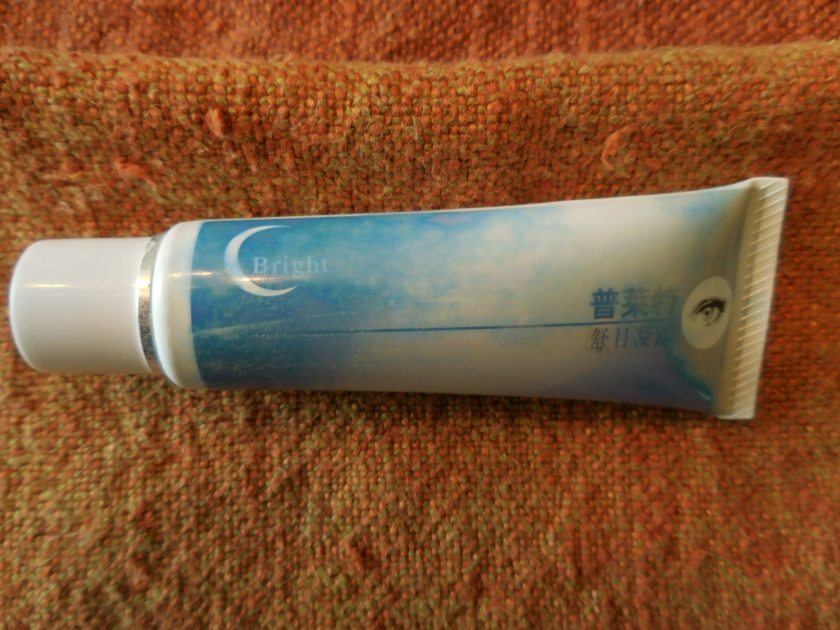
When I reemerged with newly-purchased sundries in hand, I dutifully returned to the little bazaar, to see what the ladies were selling. It turned out to be a sort of eye-relaxing gel in little blue tubes. The merchandise had obviously been acquired in bulk and was now being unloaded at a bargain discount. Moreover, an enticing promotion was in effect: If you bought even one tube of gel, you would be given a free “eye massage machine,” while supplies lasted. Apparently, the gel worked best in combination with the machine. Although I had never heard of either product, I found myself that afternoon with not much else to do, and come to think of it, a little something for tired eyes just might be the ticket. I volunteered for a demonstration.

I sat down on a little stool, and a slightly more mature  young lady (college age?), who, I hoped, had taken the five-minute course on how to apply the stuff, sat likewise on a stool, directly in front of me and actually between my legs. She directed me to close my eyes, and after my lids were shut, she began to apply the gel with her fingers to the outsides. The substance did have a cooling effect, and the overall experience was quite relaxing and a little hypnotic. Then the young optomasseuse announced that it was time for the machine. Her fingers withdrew from my eye sockets, and I heard her flip a switch. A little motor began buzzing, and then I felt a pulsating plastic globe gently kneading in a circular motion upon my closed eyes. I wasn’t sure whether I enjoyed it or not; I liked her fingers better. At any rate, she kept it up for only a few minutes, and then the buzzing stopped, signaling the end of the demonstration. She wiped the residual gel off my eyelashes with a Kleenex. Of course, I bought a tube of the gel and took possession also of the “eye massage machine,” which the optomasseuse showed me before putting into its box. It was a five-inch wand, battery powered, with about four or five interchangeable heads, such as smooth, rough, and ribbed. For some reason, it had a Playboy bunny symbol etched on its surface.

I thanked the optomasseuse for everything and rose to leave, but at that moment the sky opened up and it began pouring, very heavily for Beijing. There was nothing to do but to wait under the overhang, and the little sale area became an even friendlier island of refuge in the storm, as nothing brings strangers together better than a little shower. The gaggle of high school girls became especially peppy, and one of them sidled over to me. We exchanged pleasantries, but almost immediately, she began telling me about her boyfriend. I was not unprepared for this sudden revelation, for one of the graver responsibilities of an American man in China is to serve as impromptu confidante, counselor, and confessor for Chinese womanhood.

“Do you love him?” I asked, cutting to the heart of the matter. It seems I was always asking women “Do you love him?” back then.

Naturally, the girl didn’t know. I studied her carefully. She was no dope, bright and venturesome (she had, after all, come right over to me), just inexperienced.

Suddenly, I wanted to be in a French New Wave movie. “You see that white van in the parking lot?” I asked her. “Let’s run out, touch it, and run back.”

I’m sure she had never received such a proposal before. She beamed at the novelty but wanted to make certain what I was asking. “You mean that white van?” she pointed. “You want to race me through the rain, touch the van, and run back here?” She used a different word for “touch” from what I had. I’d said peng (碰); she said mo (摸), which sounded to me more like “stroke.”

“Yes,” I said. “Let’s run out and stroke the van and run back.”

Without another word, she screamed and took off into the deluge, and I followed. It was like a whirlwind, sprinting with the rain flying off our faces and pelting my freshly-massaged eyes, nearly slamming into the van, stroking its slippery surface, then stomping through lake-like puddles and back up the steps to the Modern Plaza, where everyone was cheering (if this happened today, all phones would have been on us) and marveling at the American graduate student and his dashing ideas. The girl and I were both soaked, her corporate t-shirt most of all, and people gave us towels.

We dried off, still panting; but there was a certain let-down of excitement, after our little race in the rain. The other stranded shoppers turned away, and the distance reestablished itself between me and my running mate. The downpour soon passed, and I bade her safe travels, took up my shopping bags, and returned to normal life.

For the next week or so, I continued to use the relaxing gel and the “eye massage machine,” before I realized that it was a vibrator (duh) and felt silly prodding my eyes every evening with a vibrator. I don’t think any of the high school girls at Modern Plaza that day knew what they were pushing, and their ignorance contributed to my obtuseness, for, since no one was behaving as though they were trafficking vibrators, I never saw that they were. If I were to chance upon a group of people talking into bananas, I would assume that they were telephones.

I donated the “eye massage machine” to a female friend who could make better use of it. I kept the gel…and the memories.
DSCN0124