Book Review: Seraph on the Suwanee, by Zora Neale Hurston

“Putting food on the table” is what both husbands and wives do. In traditional marriages, however, the husband does it figuratively while the wife does it literally. The separateness of these two modes of devotion leads both husbands and wives to feel that they are laboring alone, and both grow resentful.

In Seraph on the Suwanee, the husband, Jim Meserve, makes clear from the outset that his view of marriage is not as an equal partnership. As he conveys “in so many words” to wife-to-be Arvay Henson, “‘Love and marry me and sleep with me. That is all I need you for. Your brains are not sufficient to help me with my work; you can’t think with me. Let’s get this thing straight in the beginning.’” (p. 35) Indeed, Jim’s idea of connubial sex is quite explicit: “‘Sure you was raped, and that ain’t all. You’re going to keep on getting raped.’” (p. 57)

As Arvay is Seraph’s protagonist, the course of her resentment at this type of marriage forms the main thread of the narrative. What’s surprising – or perhaps unsurprising, given a grasp of human nature in all its irony – is how much Jim resents it too:

‘I feel and believe that you do love me, Arvay, but I don’t want that stand-still, hap-hazard kind of love. I’m just as hungry as a dog for a knowing and a doing love. You love like a coward. Don’t take no steps at all. Just stand around and hope for things to happen out right. Unthankful and unknowing like a hog under an accord tree. Eating and grunting with your ears hanging over your eyes, and never even looking up to see where the acorns are coming from. What satisfaction can I get out of that kind of love, Arvay?’ (p. 262)

Adding complexity to this story of resentment is its symbolism, with the “cracker” Arvay representing the Old South and the hustling Jim standing for the New. Perhaps the former, sullen and parochial, can only be dragged forward by the latter, enterprising and propulsive; and perhaps this dragging does not allow for much collaboration or consultation. It’s certainly ironic that a progressive development  – the modernization of the South – should be depicted here in the context of an unprogressive marriage: Arvay finds her liberation in submission, and if any beneficial readjustment of marriage roles takes place, then I must have missed it. It may be that Hurston prizes the social and economic improvement of the South over the raising of the status of women…

…or maybe her point is that the South hasn’t quite changed enough. Otherwise, it’s very strange for Hurston to have painted Jim as such a know-it-all of a husband, only to admit in the end that hubby really does know best.

Book Review: When True Love Came to China, by Lynn Pan

Lynn Pan’s When True Love Came to China is one of the most fascinating books I’ve ever read about anything. It argues that China was a stranger to love – or at least to “true love” – until the New Culture and May Fourth movements of the 1910s, when love was imported to China from its Western place of origin.

To make her case, Pan reviews Chinese and Western literary sources and shows that China, where “feeling” and “lust of the mind” were indeed well known, nonetheless fostered only a pragmatic experience of male-female coupling, due to the prevalence of arranged marriage and also to the Confucian preoccupation on moral perfection, which left little room for supposedly frivolous pursuits such as being in love. It fell to the Western mind, with its predisposition toward religious ardor, to develop the tradition of ecstatic devotion to one person. Even if the reader is uninterested in China, Pan’s chapter on the idea of love in the West is worth the price of the ticket.

That Pan limits her search for love to the Chinese and Western literary corpora tempted me to call foul, for love, as I thought, must surely evince itself outside of books. Psychologists, anthropologists, ethnomusicologists, and folklorists might be even more insistent that Pan’s approach is myopic and that a better-directed hunt for love should also lead through their respective fields. Upon reflection, however, it makes sense that broader cultural phenomena such as love would sooner or later find expression in books, with the more significant phenomena garnering the most articulation. When True Love Came to China is in fact a monumental testament to the importance of books. Pan’s treatment of China’s pioneering lovers of the early twentieth century makes the primacy of book-borne sensibility undeniable.

When Pan quotes from Yu Dafu’s (1896-1945) letter to Wang Yingxia (1908-2000) – “Oh Yingxia! You are truly my Beatrice.” (p. 204) – she clinches both arguments, proving that love is a Western import to China and that books are important. Earlier chapters of When True Love Came to China highlight the role played by Ellen Key (1849-1926) and her book Love and Marriage, as well as the better-known effect in China of Henrik Ibsen’s (1828-1906) play A Doll’s House, in which the protagonist Nora walks out on her family. Nora is shown to be the role model proposed by the ardent Xu Zhimo (1897-1931) to the married Lu Xiaoman (1903-1965) in Xu’s exhortation for her to leave her husband and run off with him (p. 217).

For love to flourish, freedom and the idea of personality (see p. 163 and thereabouts) must also be secured, and Pan traces China’s quest for these latter prizes as well. The liberation of women, obviously, becomes an important part of the story, and students of this subject will find much in the way of further reading in Pan’s bibliography.

There is simply too much here – love, freedom, religion, marriage, feminism, history, China, Japan, Europe – for the present reviewer to summarize. When True Love Came to China is enthralling from so many angles. It is essential reading for life.

Book Review: Go Tell It on the Mountain, by James Baldwin

James Baldwin’s Go Tell It on the Mountain is exquisitely written and filled with poignant truths. Here’s one concerning the resentment of children toward dutiful parents:

Through a storm of tears that did not reach his eyes, he stared at the yellow room; and the room shifted, the light of the sun darkened, and his mother’s face changed. Her face became the face that he gave her in his dreams, the face that had been hers in a photograph he had seen once, long ago, a photograph taken before he was born. This face was young and proud, uplifted, with a smile that made the wide mouth beautiful and glowed in the enormous eyes. It was the face of a girl who knew that no evil could undo her, and who could laugh, surely, as his mother did not laugh now. Between the two faces there stretched a darkness and a mystery that John feared, and that sometimes caused him to hate her. (p. 22 of 1963 Dial Press edition)

Here’s one concerning the resentment of wives toward dutiful husbands:

Sometimes it occurred to him to do the Saturday shopping on his way home, so that she would not have to do it; in which case he would buy a turkey, the biggest and the most expensive he could find, and several pounds of coffee, it being his belief that there was never enough in the house, and enough breakfast cereal to feed an army for a month. Such foresight always filled him with such a sense of his own virtue….She would sit in the kitchen, cold with rage and staring at the turkey, which, since Frank always bought them unplucked and with the head on, would cost her hours of exasperating, bloody labor. (pp. 93-94)

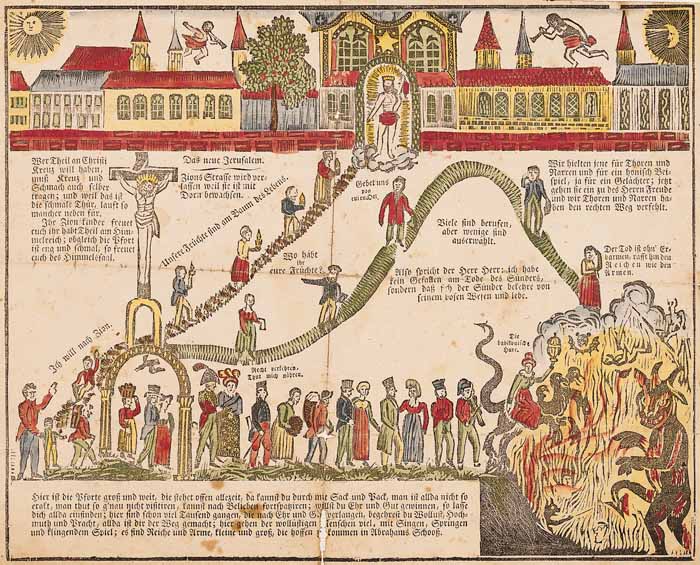
Upon the whole, though, the book is dominated by the binary relationship between sin and salvation. “‘You think that’s all that’s in the world is jails and churches? You ought to know better than that, Ma.’” (p. 25) Somewhat monotonously, few characters in the book do know better than that. The existence of a third way is hinted at very occasionally, as in “Perhaps his life had been wicked, but he had been very good to her” (p. 177); but Baldwin never suffers his characters to elaborate upon it, nor does he ever do so as narrator, for the result, no doubt, would be didactic. Rather, Baldwin lets the binary stand, leaving it to the reader to lament.

Even if the fork in the road offers only two choices, one path should lead to redemption…shouldn’t it?