Book Review: Metagestures, by Carla Nappi and Dominic Pettman

Metagestures, a collaboration between Carla Nappi and Dominic Pettman, is an homage to Vilém Flusser’s 1991 book Gestures (Gesten in the original German), which the reviewer has alas not read. Owing to this ignorance, I’m somewhat unclear on the significance of the gesture, which seems to me a superfluity, one step removed from more easily graspable themes. Looking through the table of contents, where the authors’ treatments of “The Gesture of Writing,” “The Gesture of Speaking,” and “The Gesture of Making,” etc. are all set out, I cannot help but see them as unnecessarily cluttered approaches to Writing, Speaking, and Making. Isn’t a study of The Gesture of Writing essentially a study of Writing?

So I guess I don’t get the gesture part. However (and here I raise my pointer finger and incline my head toward it in a Gesture of Qualifying, even though the “however” would have been sufficient), Metagestures is fresh and delightful, just the kind of experimental yet accessible literature that can reinspire a jaded reader. If there isn’t a Gesture of Being Glad I Read Something, there should be – and I would be making it now.

Nappi and Pettman take turns addressing every subject, with Nappi offering prose poetry and Pettman short stories. Actually, Nappi’s contributions nearly defy description but tend toward the shape-shifting, supernatural, and symbolic. I call them poetic because – well, check this out:

He sat on a log on the beach in the drizzle and watched the water fall toward him and pull back out again and he saw that the water had fingers that tried to grip the sand as it was dragged back into the sea and he saw tendrils in the foam on the sand as the watery women put their heads and faces down and flung their hair out to try to reach him, just a little bit, just for a little bit, before they had to leave again.

He was lonely.                                 (p. 183)

Two sentences, each a paragraph, one long, one short, balanced, exquisite, and devastating.

Pettman’s sections are more straightforward, but his take on “The Gesture of Making,” envisioning a factory where workers make do, make light, and make fun is a big smile.

Sometimes the authors’ half-chapters cross-reference, and they seem to work toward a climax of sorts in the concluding Gesture of Loving, which makes the meaning of the gesture a little clearer.

Or maybe it’s obvious throughout, as conveyed by Nappi (via Vilém):

Vilém read, and his emotions were written on his face by the twisting of ropy eyebrows and the pull of flesh and hair around his nose and chin. Eyes and skin and nostrils gathered into a text…                                                                                                         (p. 26)
Mississippi Egrets Haiku

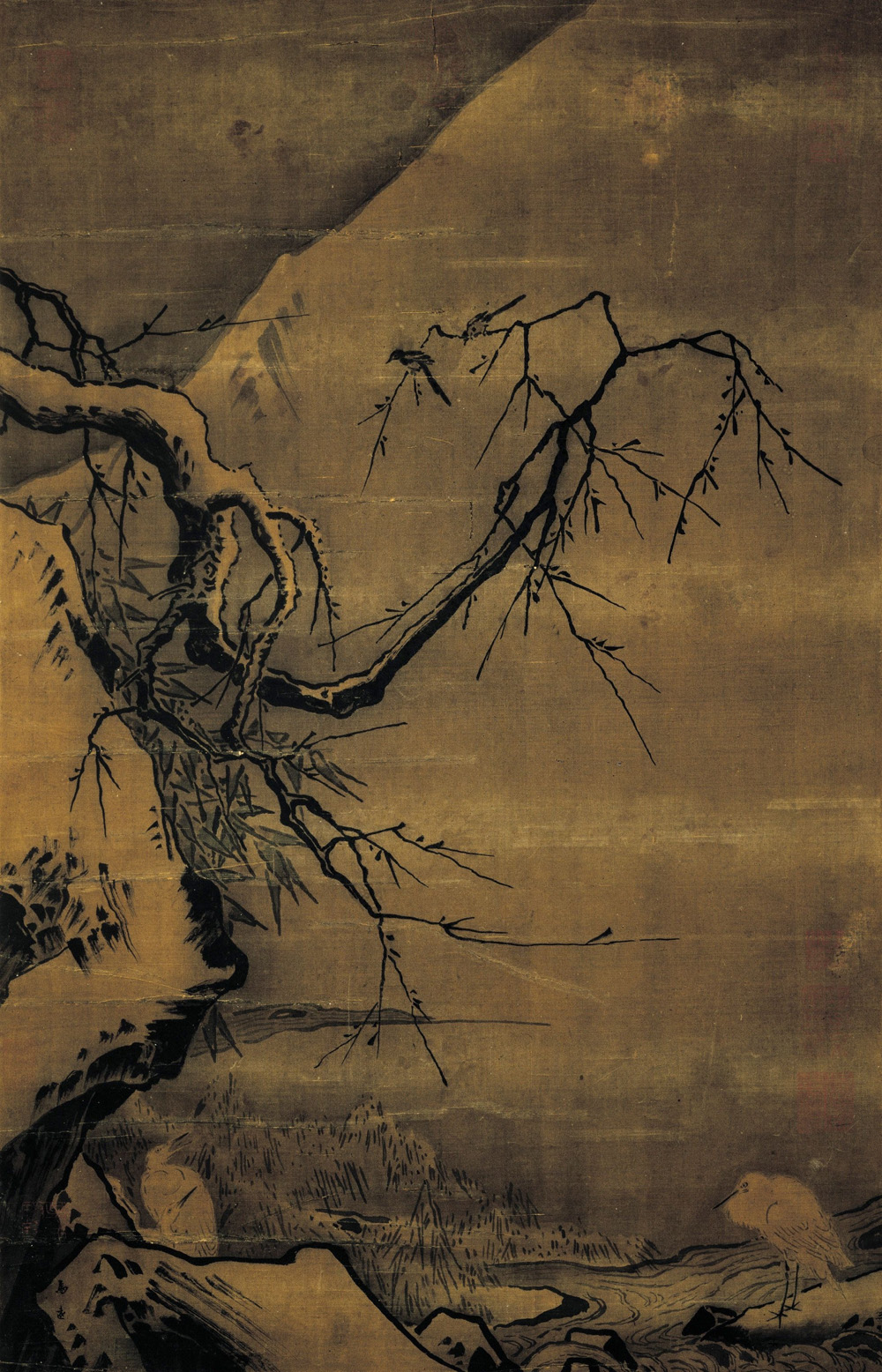
Last Saturday (September 20, 2008), I went canoeing down the Black Creek River in Mississippi. All day long, there were these two egrets in front of us. They rested in trees along the bank, until we almost caught up to them, and then they would fly a few yards downstream, to wait for us to come up. No matter how swiftly or slowly we paddled, they were always there, leading us. We stopped for an hour to eat and swim, and when we got started again, they got back to guiding us. It was so quiet, you could hear the fluttering of their wings. It was poignantly unreal, like a Chinese or Japanese poem, painting, or film.

Back home, I composed a mediocre English and (with Yuka’s help) a pretty good Japanese haiku.

Autumn, the river,
Egrets constantly guiding,
Leading us downstream

夏過ぎて
白鷺共に
川下リ

(Natsu sugite
Shirasagi tomo ni
Kawa kudari)

Taiwan Journal: Typhoon Day

Taipei, Taiwan, ROC                                    August 30, 1990

Hearkening back to the treasured, yearned-for “snow days” of grade school, today’s typhoon day seems now to be even a greater surprise and pleasure, simply because it was so unexpected as to be not yearned for at all. The day has been passed amiably here in Yonghe, with the first house meal cooked by housers from the ground up, as well as a great deal of newspaper reading and a three hour nap.

Looking out the window, I’m amazed that there can be so much water anywhere in the world, let alone falling out of the sky. Scores of aerial funnels run off of the corrugated fiberglass roofs and window-covers of the buildings across the alley, as though the apartments were sweating profusely or otherwise manufacturing the unbelievable quantities of the stuff in some interior factory or workshop.The rain is as a curtain, or rather an endless series of curtains (hanging across, parallel, perpendicular, at every conceivable angle to me) when in the atmosphere, before it touches or piles up against anything. In contact with the earth (or under the circumstances, itself), it is a pulsating, translucent force that laps and spits through gutters and drains, or slides off rocks. Reclining in bed after my 3-hour nap, I wondered about the one (or two or three) drops in this vast world of rain that would somehow be blown horizontally by the occasional gust of wind, blown through my window garden, penetrating my screen and flying underneath the billowing curtain, to land, or to touch, as a soft waft of moisture, my legs, arms, and face.

I was stirred to attempt a poem, following the above line of verbal reasoning. My thoughts turned to a sonnet tempo and then began to examine different questions of perspective: Should I be lying down, feeling the moisture coming through the window under the billowing curtain, or should I be kneeling at the window, observing the deluge outside. Although I’d been doing both all day (as well as walking in it and ignoring it), it seemed too dynamic to include both postures in a poem that would have best been a static vignette. Fumbling with the moral of the poem (one referring to poetry itself, preferably) proved to be my ultimate undoing.

I suppose poetic states of mind should accommodate the flow of words and feelings, though not necessarily of stimuli. It seems I’m better at describing natural events with a natural [illegible].

Book Review: Memories of Mount Qilai: The Education of a Young Poet, by Yang Mu

Memories of Mount Qilai is a prose poem based on youthful reminiscences of Hualien and other places in eastern Taiwan. It (via this translation) is very beautiful and hypnotic, so much so that it will often make you think of other things, until you are turning the pages without absorbing or even reading the words. Yang Mu is an excellent poet, and some of his conventional, individual works are included here, including (from p. 159):

Carrying an oil paper umbrella
alone, I make my way down a
long, long and lonely lane in the rain,
pacing back and forth, hoping to encounter a
young woman knotted with sadness and hate
like a bud of lilac

However, if the cited shorter poems are emotionally compressed, with a high ratio of meaning to word, the prose poetry of the overall book is the opposite: meandering and unfocused, rather obscure. A chapter toward the end concerning a friend who committed suicide never seems to come to any point of power or intensity.

Still, though, some passages will differentiate themselves from the meandering flow and make an impression on you, such as (on p. 201)

The sound I heard, beyond being entangled in my own questioning, was the sound of bicycles braking high on the slope above the north end of the bridge, the sound of bicycle chains.

I knew it was the sound of school being let out. They must have lowered the flag, listened to the speech of exhortation, dispersed, and set off for home. Nine hundred male students were surging out, swinging identical book bags in the same color and with the same weight, their hats on their heads, in their hands, or, like mine, thrust into their book bags. I didn’t attend the flag-lowering ceremony today. Starting around noon, I couldn’t sit still, as a strange, unformed melody floated through my mind, as if from the other side of a high, dark, ancient wall someone abandoned himself to chanting for me a fragmented but still special and recognizable song of prudence, pronouncing words that were difficult to understand but occasionally stressing a certain expression, seemingly also what I frequently heard between sleep and wakefulness. I looked around me: the distant sky, sea, prostrate mountains, the aged banyan tree, hibiscus, canna lilies, and the beehive under the eaves, steadily growing larger by the day. ‘How am I to let go, be free, release myself, and be different from others?’ I repeatedly asked myself such silly questions and then when totally exhausted, ‘How can I prove that I am different from others?’ The blackboard was covered with proper nouns: ‘Age of Enlightenment,’ ‘feudal lord,’ ‘serf,’ ‘guild,’ ‘Galileo,’ ‘isolationism,’ and ‘indulgence.’

Of course, poetry is the best proof that one is different from others. In a passion of ‘unsociable eccentricity’ (on p. 142), Yang asserts, ‘My form of expression is my own….This is the best. No one else has come up with it before; it belongs entirely to me, appropriate, exact, and effective.’

Yang’s book is subtitled ‘The Education of a Young Poet.’

On the Difficulties of Translating Chinese Poetry

I once gave a talk as part of a ‘Lost in Translation’ series on rendering Chinese poems into English. I presented my translation of the Tao Yuanming poem ‘Drinking #5’ (which I posted here last week), and, although I claimed nothing for its style, related with pride how I had expanded upon Tao’s original meaning (or gone beyond earlier translations), to make it seem that he was imagining and not really observing the chrysanthemums and mountains and other phenomena described in the poem. I thought this expansive (and almost certainly incorrect) rendering would reinforce what I believe he was saying about the process of escaping bleak reality via the power of imagination.

As usual, I wasn’t sure the audience were following my abstruse argument. Some Chinese people were present, and they said nothing.

Days later, a Chinese student who had been at the talk approached me at a study abroad fair and informed me, now that it was just between us, that she didn’t like my translation at all. It was too cerebral, in her view, totally lacking the emotive element that suffused the original.

Digesting her criticism, I realized that the emotive element of Chinese poetry accounts for the bulk of its power, that this emotive aspect is the hardest quality to translate, and that the failure to capture the emotive connotation of Chinese poetry in translation was chiefly responsible for the seeming pointlessness of Chinese poetry to foreigners.

For instance: Do you know the sound of children’s swings, clanging against each other, in a deserted playground? Well, that is a Chinese poem. It’s not that non-Chinese people are insensible of the emotive potential of such a thing, but it’s doubtful that a Westerner, especially, would use poetry to convey it. He would be likelier to use more modern media. There is, of course, the sound of clanging swings in the middle of the second side of Abbey Road (before ‘Sun King,’ I think); and a similar sound and image, from a deserted playground, begins the film Midnight Cowboy. In both cases, the emotive effect is very strong.

But if you try to put it in a poem –

                The swings clang —

                ching! ching!

                Who was just playing here?

– you can’t pull it off.

I’ll speak for myself: I can’t pull it off.