Taiwan Journal: How Not To Flirt

Taipei, Taiwan, ROC                                                    Nov. 3, 1989

A flirting accomplice at the office — everyone knows her as Nancy — shared a few moments with me in the copy room. She suggested the two of us save up some bread and then go to South Africa together. When I proposed a mere movie instead, she laughed with embarrassment and was unable to say another word.

My Dream

Here is a description of a dream I had in the early 90s in Taiwan. It is the most intricate dream I have ever experienced and can be broken down into four phases:

Phase I. I am around six years old and am standing in a desolate, Middle Eastern landscape, devoid of any man-made structure, that feels like the “Holy Land.” Nearby is a small pond, and two bearded and robed young men are fishing in it. They are fussing in a primitive way, and I am rather put off by them; looking closely, however, I see that their fishing tackle consists of long blades of grass, with neither hooks nor bait, which they are swishing through the water.

Although no one speaks, the knowledge comes echoing over the hills that God is approaching. I notice a figure emerging through waves of pulsating heat, walking down an incline toward me, as I continue to stand near the pond with the two grass-fishing men. At the wordless realization “It’s Her,” I see that God is a Native American woman, apparently in her mid-twenties. She comes to stand slightly upslope from the pond, and I follow her eyes as she regards the two fishermen: They have both landed healthy-looking, silver-skinned fish, which seem willingly to have threaded themselves through the jaw on the hookless, baitless blades of grass. The men pull their catches out of the water and begin wrapping the blades of grass around their necks, with the fish held in place at the backs of their necks, above their shoulder blades. They tie the grass around their throats, climb the few paces uphill to where God is standing, and fall to their knees before Her in devotion. I fixate on the fish: They are baking in the sun on the backs of the men’s necks, curling their tails upward as they die.

God senses my distress. Turning Her attention to me, she calms me telepathically:

“You must not feel bad for the fish, nor must you think ill of these men for their ritual. They are simple, but their hearts are pure.”

She smiles. “If this ritual is upsetting to you, you do not have to follow it. You do not have to do anything that upsets you.”

She opens Her arms and hugs me to her bare chest, stroking my shoulders, neck, and the back of my head.

I enjoy perhaps five seconds of bliss in Her embrace, but then I hear a clamor to my left, like the clanging of pots and pans. I turn in that direction, and when I do so, I become part of a changed scene; I never see the pond, the fishermen, nor God again.

Phase II. I am in the same Middle Eastern barrenness, but temples and altars now dot the slope. My age is now about fifteen or sixteen.

A portly man is shuffling up to the altar nearest me. He is dressed in a khaki military uniform and seems to be a British soldier of intermediate rank, perhaps a sergeant. He is in a fretful haste and his mess kit and canteen bang together, producing the racket that had seized my attention.

I intuit that the British army is being evicted from the Holy Land and that the sergeant wants to “grab a quick prayer” before leaving. Kneeling at the altar, he begins to pray, but his vexation remains throughout, so that he is praying and cursing at the same time.

A different sort of noise, like the clattering of dishes, rolls in from the right, and I turn in that direction.

Phase III. The landscape is unchanged, but I am now twenty.

I am looking at the Last Supper, as seen in the painting by da Vinci, except that dinner is alfresco. I advance toward the central seat, where Jesus is supposed to be, and find that he is Mark Twain. The disciples to the left and right are behaving like a pack of unruly children, elbowing each other and knocking over their drinks; and Mr. Twain wears an expression of the most grudging indulgence, brimming with sarcasm, rolling his eyes as if to say, “You’d better have mercy on these clowns, Father, because I just want to strangle them.”

I sit opposite Mr. Twain, and we begin sharing the same dish, passing the plate back and forth, helping ourselves to a little at a time. After a few rounds of this exchange, Mr. Twain scrapes off the last morsel and returns the empty plate to me. He produces another supernaturally ironic smile.

An electronic beeping from my right distracts me, and I turn to look.

Phase IV. I am twenty-four (the age at which I had the dream) and in Taiwan (where I lived when I dreamt it).

I am in a cavernous big-box warehouse store. Merchandise-laden shelves tower heavenward, reaching almost to the bare rafters, eclipsing the light. I’m standing in the checkout line, along the conveyor belt, just behind my American roommate, waiting for him to complete his purchases. However, he begins hitting on the cashier, a Taiwanese girl barely twenty. She is unresponsive and unamused. She reaches under the counter, pressing a button, at which the whole scene becomes an image on a TV screen, a video recording now serving as evidence at my roommate’s trial for sexual harassment. The End.

My interpretation: Each phase of the dream seems to correspond to a moment in world history and in the development of religion. Phase I is the Primitive phase, showing the hopeful moment when a religion of ritual evolves into a religion of love. Phase II is the British or imperialist phase, in which religion has been corrupted by power, significantly an unsustainable power. Phase III is the American phase, based on a parody of a painting, populated by quarrelsome chosen ones, and devoted to the worship of Irony, which proves an unfulfilling dish. Finally, Phase IV depicts the post-historical age in which we live: materialist, litigious, godless, and loveless.


Book Review: The Stolen Bicycle, by Wu Ming-yi

Here is a passage from toward the end of the book:

I rode around [Taipei] but felt I didn’t know her anymore. She keeps on getting renewed, over and over again, as if in a rush to shed some sort of shell, the grotesque, mournful, scandalous past. With each renewal, so many things that shine with an incredible radiance in many people’s memories disappear. I felt a bit sorry and lonely. ‘Yes, this is gone, and that too!’ I could say that on practically every street. (p. 334)

Here is another passage, from more toward the end of the book:

I rode circles around the city, ring upon ring. As the slowest vehicle on the road, I was able to appreciate scenes the others left behind. (p. 359)

These two passages suggest the purpose of The Stolen Bicycle: to recapture, before it’s too late, the “grotesque, mournful, scandalous past,” which has already been erased from view but which yet lingers in memory. Using the protagonist’s father’s lost and found bicycle as a device, Wu Ming-yi embarks on an odyssey through a hundred years of Taiwanese history. His footsteps take us through the provinces of culture, including material culture, language, psychology, and family. The subtle implication of his narrative is that Taiwan is no mere subset of China but a unique mélange of aboriginal, Fujianese, Japanese, postwar Chinese, and Western influences.

Despite the overarching melancholic nostalgia, the tone of The Stolen Bicycle is actually rather positive.  Absent is the entitled, cosmic angst of Western literature, and the element of conflict is likewise missing. Instead, Wu’s narrator copes with bleak reality by cultivating private enthusiasms such as antique collecting and bicycle restoration. Often this sort of occupation leads to camaraderie (say, with fellow junk collectors), creating a sense of fellow travelers if not intimate friendship. Obviously, the attention given to junk collecting in the story points to the larger task of the writer, as he forages through Taiwan’s past; but the feeling of wandering souls coming together stands in contrast to the strife for its own sake that one often finds in Western novels. (I wonder if some generalizations along these lines might be food for thought.) The passage describing a somewhat paranormal scuba dive in the basement of an old building makes it especially difficult not to think of Haruki Murakami. Perhaps Wu’s Taiwan, like Murakami’s Japan, is an outwardly peaceful but historically troubled land, compelling its literary types to become detectives of the past, as a sort of therapy.

I have made a study of Taiwanese literature in recent months and can report that The Stolen Bicycle may be the most accessible recent work to have been translated into English and therefore the most pleasant to read. Many other recent Taiwanese books have been written using experimental methods, like stream of consciousness. The Stolen Bicycle, by contrast, follows a straightforward first person narration, and it is, again, a lot like a detective story. I previewed this book in electronic form, which I don’t generally enjoy, but I found it nearly impossible to stop reading, even on a computer screen. It is jarring, about two-thirds of the way through, when the narrative device switches briefly from bicycles to elephants; but that is a minor complaint. The Stolen Bicycle is a fascinating book about a very special place.

Taiwan Journal: The Firecracker Gauntlet

Here is the diary entry from my first Chinese New Year’s in Taipei.  The experience stayed in my mind and became the inspiration for the first few pages of my novel, Southern Rain, now available for pre-order on Kindle. You can click on the link on the sidebar of this blog.

February 7, 1989                                                 Taipei, Taiwan, ROC

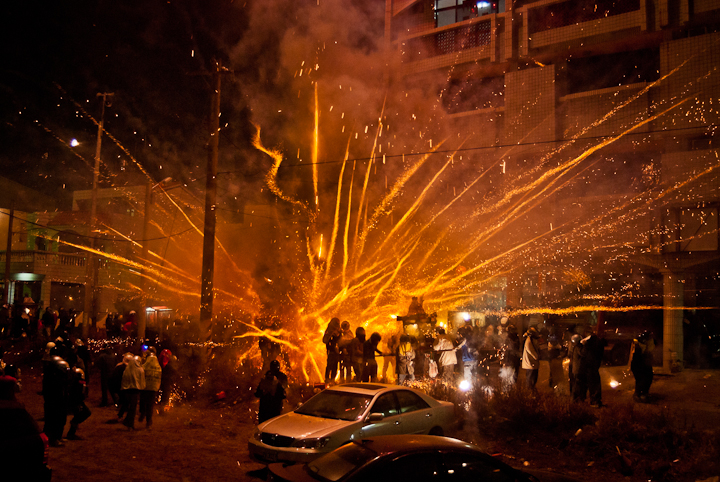
This town is crazy with fireworks. Small children employ every conceivable sort of artillery, turning every thoroughfare into a gauntlet of bouncing fireballs and air-shattering explosions.  The missiles ricochet off storefronts, apartment buildings, parked cars, speeding taxis, motorcyclists, and pedestrians. Traffic moves nonchalantly through the minefield, zigzagging around the volcanoes, which burst in their grand finales, right when a car passes alongside. I’ll never forget the sight of this old pedicab salesman, hawking his wares as he pedaled down the street, bottle rockets snaking along the pavement to explode directly beneath him or bouncing off of his torso. He kept idiotically crooning his sales tune, a living fountain of sparks. A lovely vignette!

Book Review: Memories of Mount Qilai: The Education of a Young Poet, by Yang Mu

Memories of Mount Qilai is a prose poem based on youthful reminiscences of Hualien and other places in eastern Taiwan. It (via this translation) is very beautiful and hypnotic, so much so that it will often make you think of other things, until you are turning the pages without absorbing or even reading the words. Yang Mu is an excellent poet, and some of his conventional, individual works are included here, including (from p. 159):

Carrying an oil paper umbrella
alone, I make my way down a
long, long and lonely lane in the rain,
pacing back and forth, hoping to encounter a
young woman knotted with sadness and hate
like a bud of lilac

However, if the cited shorter poems are emotionally compressed, with a high ratio of meaning to word, the prose poetry of the overall book is the opposite: meandering and unfocused, rather obscure. A chapter toward the end concerning a friend who committed suicide never seems to come to any point of power or intensity.

Still, though, some passages will differentiate themselves from the meandering flow and make an impression on you, such as (on p. 201)

The sound I heard, beyond being entangled in my own questioning, was the sound of bicycles braking high on the slope above the north end of the bridge, the sound of bicycle chains.

I knew it was the sound of school being let out. They must have lowered the flag, listened to the speech of exhortation, dispersed, and set off for home. Nine hundred male students were surging out, swinging identical book bags in the same color and with the same weight, their hats on their heads, in their hands, or, like mine, thrust into their book bags. I didn’t attend the flag-lowering ceremony today. Starting around noon, I couldn’t sit still, as a strange, unformed melody floated through my mind, as if from the other side of a high, dark, ancient wall someone abandoned himself to chanting for me a fragmented but still special and recognizable song of prudence, pronouncing words that were difficult to understand but occasionally stressing a certain expression, seemingly also what I frequently heard between sleep and wakefulness. I looked around me: the distant sky, sea, prostrate mountains, the aged banyan tree, hibiscus, canna lilies, and the beehive under the eaves, steadily growing larger by the day. ‘How am I to let go, be free, release myself, and be different from others?’ I repeatedly asked myself such silly questions and then when totally exhausted, ‘How can I prove that I am different from others?’ The blackboard was covered with proper nouns: ‘Age of Enlightenment,’ ‘feudal lord,’ ‘serf,’ ‘guild,’ ‘Galileo,’ ‘isolationism,’ and ‘indulgence.’

Of course, poetry is the best proof that one is different from others. In a passion of ‘unsociable eccentricity’ (on p. 142), Yang asserts, ‘My form of expression is my own….This is the best. No one else has come up with it before; it belongs entirely to me, appropriate, exact, and effective.’

Yang’s book is subtitled ‘The Education of a Young Poet.’

Lost and Found

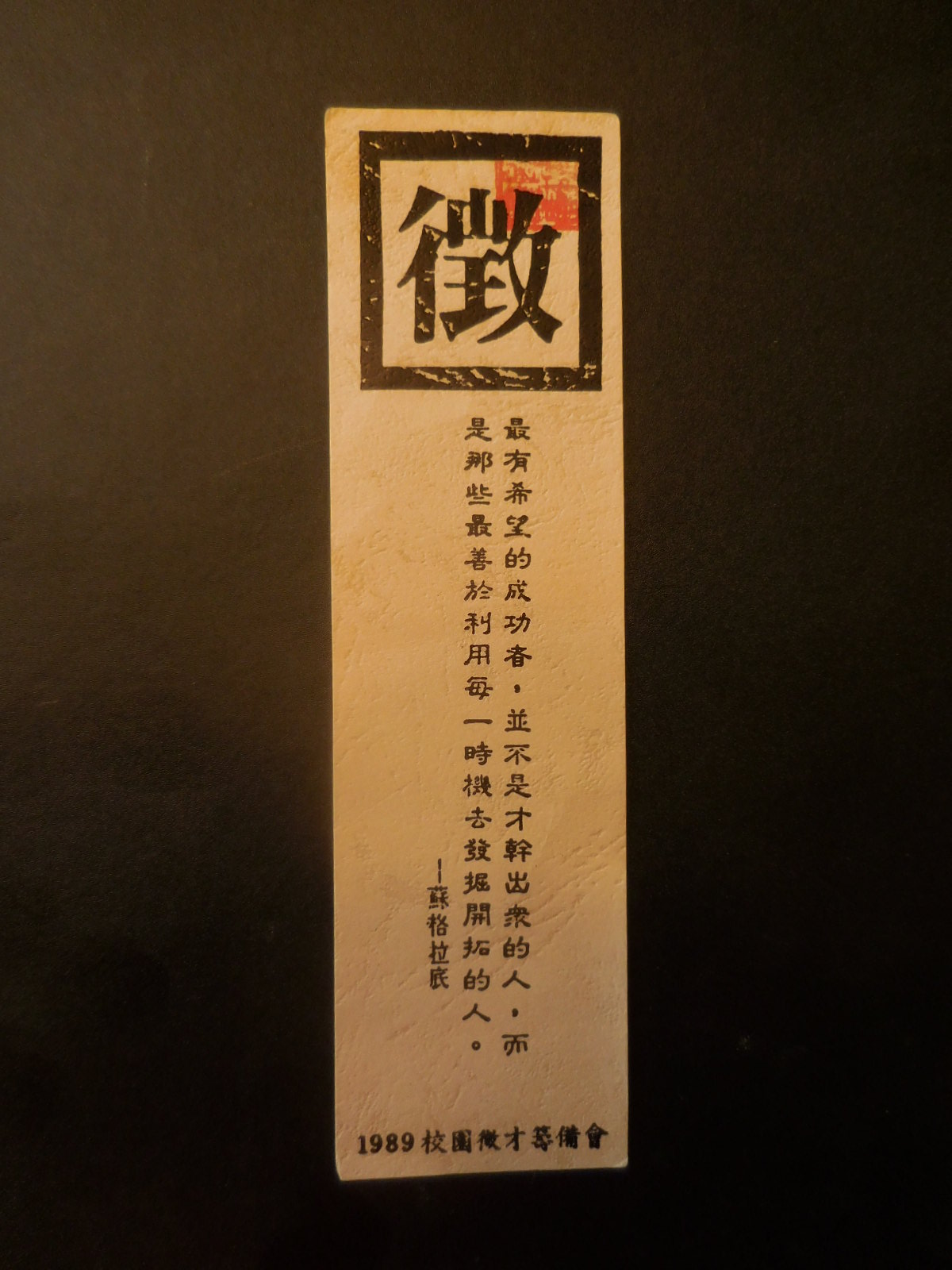
By some miracle, a bookmark that I acquired in Taiwan in 1989 has remained in my possession, showing very little wear and tear, in spite of my indifference to it. I always thought it was cool – Its character style and the fact that it contains a quotation from Socrates are very evocative of Taiwan – but I never took any care of it. (After all, it’s just a bookmark.) Over the years, I occasionally employed it in its intended capacity, paying it no more mind than if it had been a shop receipt or piece of Kleenex, and then, the book read, I would leave it lying around for the next time. I don’t know how many places I’ve lived since 1989, but the bookmark survived them all.

Recently, while reading Jonathan Manthorpe’s Forbidden Nation: A History of Taiwan, I remembered the bookmark and decided that it would complete my experience. Then, after enjoying both book and bookmark, I resolved to make the latter a mandatory accompaniment to my upcoming immersion in Taiwanese fiction. With my determination fixed, I sought for the bookmark, to make sure everything was prepared; but I could not locate it. It was on no dusty nightstand or bookshelf, where it always was, where all the other bookmarks were. I checked my office, my car, and even less likely places, in increasing despair.  I realized that it was an irreplaceable antique, of tremendous personal value, the central artifact of my youth. I felt bereft and aggrieved, like a man missing a limb. I slept very little.

The following morning, I dashed to my car and arrived at the library, well before opening. As soon as the door was unlocked, I charged inside and implored the young man at the circulation desk to search every cart where a book returned the previous day might be. Finding the Manthorpe on the fourth or fifth cart, I flipped through the pages and there found the object of my quest, preserved as though in amber. I returned home and, at the foot of my bed, wept tears of gratitude.

Here is what it says:

HELP WANTED

“The most promising successful people are not those who possess uncommon talent but are, rather, the ones who are most adept at exploiting every opportunity for self-development and discovery.”

— Su-ge-la-ti

1989 Campus Career Fair

Tales of Old Taipei: The Fake Rolex Man

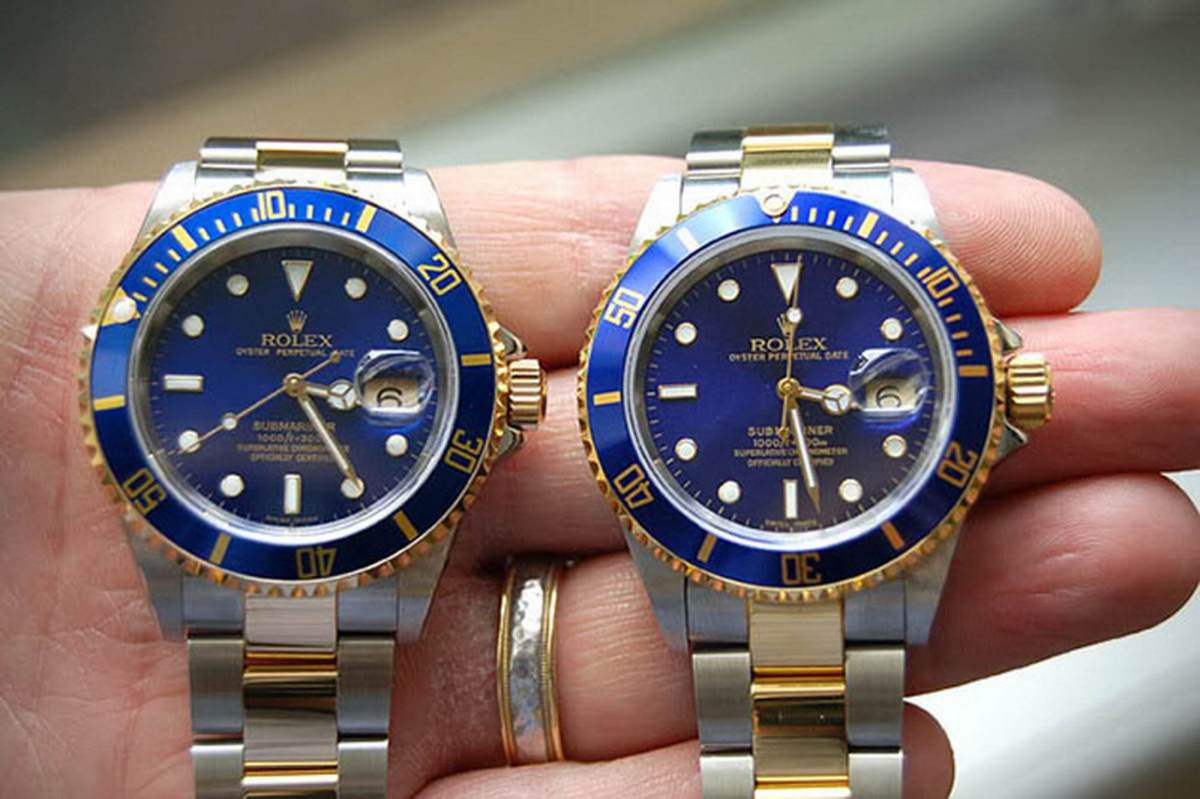
My Taiwanese employer would frequently open its doors to a variety of hustling salesmen and invite them to peddle their wares to the staff. By far the most popular of these characters was the fake Rolex man, who graced our workplace every couple of months.

The rapturous tidings “The fake Rolex man is here! The fake Rolex man is here!” accompanied by eager foot beats, would herald his arrival. The honored huckster would set up shop in the conference room next to my boss’s office, and I was able to observe the stream of breathless coworkers, arriving singly or in groups, carefully appreciating the counterfeit treasures and, more often than not, emerging with small handfuls of them, grinning proudly. Returned to their desks, they enjoyed much celebrity, as others of their departments gathered around to marvel at the loot before succumbing to envy and hurrying over to see what bargains remained. It was all very amusing to me and broke the monotony of long afternoons poring over telexes.

Once during the lunch hour, on the day after a visit from the fake Rolex man, my boss, whose English name was William, took me aside.  He put his arm around my shoulder.

“You know, ah, we’re very concerned about you,” he said.

“Oh?”

“Is everything all right?”

“Yes, William. Everything’s fine.”

“Are you homesick? You’ve been away from your own country for a long time.”

“I’m not homesick…  Have I made some kind of mistake on the job?”

“No, that’s not it. You just don’t seem to be fitting in very well.”

“I don’t?”

“No,” William said, and then he grew even more serious. “For example: Yesterday, the fake Rolex man was here, and you didn’t buy anything. You didn’t even have a look.”

“Well, I don’t need a watch. I already have one.”

William tisk-tisked. “But surely you sometimes need to give presents. Don’t you have a friend who would like a nice fake Rolex?”

“Why would I give a friend a fake Rolex?”

“Harry, Harry.” He looked around to ensure that no one had overheard my sacrilege. “The fake Rolex man is here to help,” he said. “You should take advantage of every opportunity to obtain good fake merchandise. If you don’t, you’re just… It’s just not healthy.”

I didn’t know what to say.

“Promise me you’ll have a look next time,” he implored. “You really owe it to yourself.”

I promised, but I was bummed. The watch I wore every day was an art-deco knockoff I’d picked up in Gongguan for twenty-five cents, and it kept perfect time; but did anyone notice? Did anyone give me any credit?

Everyone always assumed I was the maladjusted foreigner. I was tired of it.

Taiwan Journal: Youth in the Rain

August 23, 1989                                Taipei, Taiwan, ROC

An interesting set of people at the bus stop shared the thirty minute wait for the 0-East. One, of course, was a very poised woman. She smoked a cigarette, and once, when our eyes met, she smiled naturally and pleasantly. There was also this guy who I’d seen before. He had thick glasses and was kind of fish-eyed and muckle-mouthed, probably not very popular at school. I found myself trying to avoid looking in his direction, for some reason, until I noticed something unusual about his t-shirt. It was a political shirt, bearing the slogan, “You have the right to reject this Taipei.” Suddenly, I seemed to understand him, as though I recognized the same pattern in his life that I’ve seen in the States: Cast out of the crowd by forces not in anyone’s control, the outcast studies alienation itself, turning inward and moving out, trying to return to the scene armed with the ideas of exile. I lent him my umbrella.

The ensuing rain blossomed into a true thunderstorm while I sat in the front of the bus watching. It was a heaven-sent washing. Raindrops on the puddles in the street seemed to suggest a soft meadow. There was a mellowing of light and sound, under the auspices of a friendly patter of droplets, the splashing of tires, and the creaking of wipers. The rain tames us.


August 28, 1989                                Taipei, Taiwan, ROC

I had an interesting experience today worthy of a French movie. As I hopped off the 0-East at the Nanchang Street stop, I noticed a high school girl in the green blouse of the elite First Northern Girls School, braving the first drops of a downpour. After the usual hesitation, I offered her my umbrella, and I found her to be both easygoing and serious. She said right away that she too had not eaten, and we soon found ourselves in a noodle shop, under the leering gazes of the cheap girlie posters that papered the walls, discussing history, Taipei, the USA, the mainland. There wasn’t any tension at all. I didn’t get her name.

Taiwan Journal: Really Beginning to See the Light

Background: When I lived in Taiwan as a youth (1988-92), I worked at a local shipping company, and “Susie” was in the sales department – outside sales (calling on clients, not just handling the paperwork in the office), an unusual job for a woman. She had an untamed, Amazonian beauty (how surprised I was, seeing her years later [as narrated below], to find her shorter than I am). Back in the day, I had feebly hit on her a couple of times, unaware or uninterested in the fact that she was living with a guy; but then I actually started to hang out with her and her boyfriend, “Joe,” at their bar, named Joe’s Place. He was a lot of fun. By the time I left Taiwan, they were married, and she was pregnant. During my 2010 research trip to Taiwan, I got in touch with her again. She explained that she was divorced from Joe, who’d become a journalist on the Mainland. Her son, whom she’d raised alone, had recently been killed in a car accident. What follows is the last diary entry of my 2010 trip.


Friday, April 16, 2010 – Taipei, Taiwan, ROC

The plan today was to have lunch with Susie, but she’d cheesed on me, fanged my gezi [‘released my pigeon,’ i.e., stood me up], by eleven, after I’d spent two days relishing the fantasy of being her hero, her shoulder to cry on, her saving ray of warmth.

There was a vague fallback position of my hanging around until fiveish and trying her again. So I ran downtown for a fast Mos Burger (the 五彩 burger I wanted was apparently a seasonal thing, available only through last Sunday, when I’d decided I loved it). I read in my Times a review of Kick Ass, and the old Spontaneity kicked in. I began playing the game of Taipei one last time. I feinted toward Taida Hospital; then I doubled back to the Station, buying a shirt and a 方大同 CD in record time and then taking the [Taipei Metro] to magnetic 西門町, where I checked out all five theatres and finally bought a ticket at the old 絕色, with only an hour to kill. I was enjoying myself and also enjoying childish revenge on Susie (ditching her back, in other words), while feeling a little guilty about it at the same time.

I loved the film.

I called her from the stairwell on the way out. She invited me to Neihu, where I would have enough time to be with her for five minutes before having to rush off to keep my dinner date with [another couple of friends]. Rockpile’s ‘Girls Talk,’ recently my manic soundtrack, began to play in my head again, and I raced off to the Ximending station [of the Metro], out the Ban/Nan [line], transferring to the Wen/Hu [line], up those long escalators (where I saw the best leg effect ever: transparent black stockings over long anorexic legs, coming up well above the knee and terminating in a fancy pattern just an inch or two below the hem of the young lady’s short shorts, leaving an thin band of exposed flesh between the shorts and the darker pattern at the top of the stockings) since you’re not supposed to see the fancy pattern at all, it was like she was wearing her underwear around her calves)

The little car curved and sped, and I ran down the escalator, and soon there was Susie, and all was forgiven, and we hugged, and we walked back to her yingchou [social meeting with clients], and she observed that I wasn’t a boy anymore, and she smelled of drink, and we reached the yingchou, where I worked the group for a while in the customary manner.

Five minutes passed, and Susie said she’d drive me all the way to Nangang for my big dinner. We got in her Toyota, and she began telling me about how she’d raised her son alone – raised him to be her ex-husband’s son, even sending him to the mainland to spend Chinese New Year’s with his dad. She soon realized that (but could not understand why) her ex-husband wasn’t acting like a father; so she stopped sending the boy to him. When Joe took five days to return to Taiwan to see his body, she gave up trying to understand.

But she didn’t give up trying to return her son to her ex-husband’s family, where Chinese Culture deemed he belonged. I listened with no clear idea what this meant, whether he would take their name or be interred among their graves. No one, not her ex, nor anyone from his family, has come to claim the boy and take him from her. And yet she thinks she must return him to them.

She was crying.

Her Singaporean boyfriend called and at the end of their conversation she said ‘I love you’ to him three times. I’d never heard a Chinese woman say it to her man, not even once.

Susie said I should go home and raise my daughter, and that’s what I’m going to do tomorrow.